Books
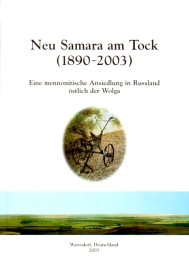 |
“Neu Samara am Tock (1890–2003)” Published by Neu Samara Publishing, Warendorf, Germany. The first part was written by Neu Samarians who emigrated to Canada in the 1920s. It was first published in 1964. The new edition was expanded to include the years after 1930. A committee in Warendorf undertook this work. The book contains many photographs and recollections of former residents of Neu Samara. It describes the founding and development of Neu Samara from many different perspectives. We used it as one of our main sources.  An English translation of the earlier book was published in 2002. It was translated by John Isaak and his sister Tena Wiebe. This edition also includes additional material and an afterword by Tena Wiebe, who is married to the well-known Canadian writer Rudy Wiebe. The German edition is available, among other places, from Lichtzeichen-Verlag. Interested readers may also contact the Mennonite Brethren congregation in Warendorf directly. In cooperation with Johann Funk, one of the editors, we can now offer the book as a PDF (14.5 MB) for download. Please observe the usual copyright restrictions; in particular, do not use the material commercially without permission. |
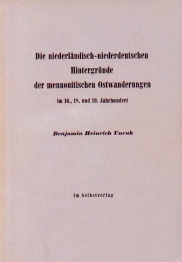 |
“Dutch and Low German Backgrounds of the Mennonite Migrations Eastward” by Prof. Dr. Benjamin Heinrich Unruh Of particular interest to family historians are the well-known lists, compiled by the author, of all Mennonite immigrants to Russia. As its title suggests, the book examines the origins of the Russian Mennonites in the Dutch and Low German regions. It is written primarily for scholars. |
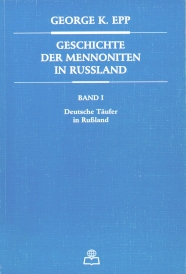 |
“History of the Mennonites in Russia” by Prof. Dr. George K. Epp (October 26, 1924 – October 25, 1997), in three volumes. The work traces Mennonite history in Russia from the beginnings of settlement through 1917. The first two volumes were originally intended to be one, but grew so large that the publisher recommended splitting them. They cover the founding and development of Mennonite settlements in Russia through about 1870, when the major emigration to Canada began. The author discusses the early difficulties and later social and religious crises in the new settlements. For example, he traces the emergence of new religious groups, such as the Mennonite Brethren, while avoiding an overly detailed discussion of theology that would go beyond the scope of the book. The third volume remained unfinished because the author died of cancer before completing it. Only five chapters were finished: – Administration and governance of German settlements, 1764–1917 – The economic development of the colonies – Education in the settlements in Russia – Alternative service for Mennonites in Russia – Mennonite daughter colonies established by Prussia and Russia Rather than offering a continuous chronological account, the work examines particular aspects of Mennonite life in Russia. The final chapter on daughter colonies is especially interesting: drawing on a wide range of sources, George K. Epp attempts to list and briefly describe as many Mennonite settlements in Russia as possible. A volume covering 1920–1970 was also planned: “This volume will deal with the experiences of the German minority under Communism” (George K. Epp). He had already conducted extensive research for it years earlier. What I especially appreciate about this book is the author’s effort to connect developments in the Russian state with the history of the Mennonites in Russia. For example, he notes that privileges enjoyed by Mennonites, such as exemption from military service, were also granted at the time to all settlers in the border regions, including Russians. Elsewhere, he describes the impact of Tsar Alexander II’s reforms on the Mennonites, including the abolition of their exemption from military service. The author also benefited from the greater access to Russian archives available to Western researchers after the dissolution of the Soviet Union, and drew on many Russian sources. Overall, this is an accessible account and, to the best of my knowledge, the most comprehensive treatment of Mennonite history in this period. About the author: George K. Epp was born on October 26, 1924, in Osterwick, Chortitza, the son of a teacher. Soon afterward, the family moved to Franzfeld in the Jasikowo settlement, where he grew up. At the age of 16, he was conscripted into the German Wehrmacht and, because of his language skills, served as an interpreter. After the war, he emigrated to Paraguay, where he helped found the Volendam colony. In 1954, he emigrated to Canada. While earning his living as a laboratory technician, he completed several academic degrees through evening courses. From 1968 onward, he was able to devote himself fully to his academic career. He taught at Mennonite Brethren Bible College, the University of Manitoba, Canadian Mennonite Bible College, the University of Winnipeg, and Menno Simons College. He retired in 1992. Detailed biography (in English) |